
Our second instalment of the Kollektiv Profile series is with French-Lebanese collector Imad, aka @thecollectionist.ae on Instagram.
Born and raised in Paris by Lebanese parents, growing up in Paris until he finished his bachelor's degree. Then moving to Spain to do his master’s degree. Then moving to Lebanon, working for three years in Beirut, before relocating in 2012 to Dubai.
Now, fourteen years later, we sat down with Imad about his watch-collecting journey.
UR: Imad, we know a little bit about your background and growing up in Paris. Can you tell us what field your career is in?
IMAD: I work in purchasing, actually. For an e-commerce company, mostly gifts, gadgets and things like that. So maybe not the best field in these current days, where people have to be quite cautious about what they're buying and how they're spending their money. But fingers crossed, we'll see in the next few months how things evolve.
UR: Yes, it's not been an easy time in the Middle East. It is still pretty quiet now. But I am sure Dubai will bounce back eventually.
Turning our attention to horology, can you tell us how your watch journey started? Was it something from your job? Because you said you're working in e-commerce and gadgets.
IMAD: No, it started much earlier, back in Paris. I have always worn a watch. I recall from even the end of the '80s having my first Flik Flak, then moving into Swatch watches, Casio, and the G-Shock. I still have some old watches from the beginning of the '90s, but then I started to take it more seriously at the beginning of the 2000s. My first big purchase was a Bulgari Carbon Gold Chrono. I don't know if you remember those; they came out with limited editions for different cities. I purchased the Carbon Gold Chrono Roma Edition of 999 pieces! It was a very nice watch, obviously an ETA movement. The price was good, below 1,000 back then. Having an ETA was no sin.

UR: After the Bulgari, what direction did your collecting take?
IMAD: After the Bulgari came a Cartier Pasha Sea Timer, then a 2010 Rolex Milgauss, and then, when I moved to Dubai in 2012, an IWC Perpetual Calendar Top Gun.

UR: Did moving from Paris and Lebanon to Dubai change your influence on what watches you were buying?
IMAD: Yeah, yeah, exactly, exactly. Look at what was easier, and at the time, also in terms of budgets. I mean, the Bulgari, imagine today if you could get the Bulgari for $1,000 brand new from the boutique. It doesn't exist anymore, the value of money is different today, the inflation and everything, but I mean, those were the brands. I even had a Fred watch, and I still have it. Brands like you could afford at a certain time, and back then, it was mainly mainstream brands at the beginning. So this is exactly how I started. And of course, I think when I moved to Dubai, the new career and the salary in Dubai helped me build my collection. At a rate I could have never dreamed of. If I had stayed in Paris, obviously, I wouldn't have had those watches. So yeah, definitely moving here was a plus in terms of collecting.
UR: Do you think of yourself as like a collector with a strategy, or do you just buy what you love?
IMAD: I just buy what I love, really. I mean, it might sound cliché. I'm very emotional as a person, so if I really like something and I can afford it, I will buy it. Now I'm from the old generation as well, so no FOMO (fear of missing out). I take my time. If I go and check a watch, I like it, I need to think about it, budget it, and then I'll come back, sometimes even years later.
UR: Do you research a watch before making a purchase, like social media, blogs or ask other collectors?
IMAD: Normally, I don't, but if there's a watch I like and I have a friend who owns it, of course, I'll ask for feedback, I'll try it on. But no, not certainly bloggers or influencers because they don't own it, they didn't put their money where their mouth is. So for me, no, it doesn't make sense. But people who actually own this piece that I like, I might ask, but at the end of the day, I'm the one who's taking the ultimate decision because they're expensive pieces as well, and what this person might like and find interesting in the watch might not be what actually drew me to this watch from the beginning.
UR: You mentioned earlier that you have been in Dubai for fourteen years. Has living in Dubai, with the different cultures, because it's a very mixed cosmopolitan crowd in Dubai. Has that kind of melting pot of different people affected your collecting at all? Do you hang around with friends who are like-minded collectors?
IMAD: Totally diverse. I mean, I have friends who only collect Rolexes, which is crazy to me, and other friends who only collect independents, which is also crazy, right?
So you're like, how do those people mix? But you're right, this is what's nice in Dubai, this mix of all those cultures, origins, in terms of collecting also, because coming from different backgrounds and different countries, you might interact with people who have a brand you've never heard of as well. I mean, it can be a British brand, a French brand. I remember a few years back when I came back from holidays, I had this micro brand, Scottish, Anordain, and people were like, " What is this? I've never seen it, because they wouldn’t, as they were only sold online, and especially at the time in Europe. So you get introduced to those brands, or someone who brought in a Raketa a few years back from Russia, stuff like that. But now, obviously, of course, in Dubai, everything is available when you can find it. But no, we're very lucky and blessed to be here and have all those mixes of people.
UR: Do you collect, between categories like vintage, modern, and independent, and has your focus narrowed over time?
IMAD: Okay, I do not collect vintages. I have the ones that my dad gave me that my grandfather owned before him. Those are emotional pieces with deep sentimental value, true family heirlooms. But no, I don't buy vintage. I never bought a used watch until my Urwerk 103. Which is over twenty years old, so like a vintage piece for an independent.
Normally, if a watch is still available brand new and I have the budget for it, I'll buy it. If it's no longer sold, then I'll try to find one on the market.
UR: Have you ever met someone like a fellow collector, someone from a brand, a mentor, ever meaningfully changed how you think about watch collecting? Is it something you share with Anyone in your family? You mentioned your grandfather’s watch.
IMAD: No, I wish. Look, I mean, we're three brothers, so I'm the only one who actually wears a watch. Yeah, so neither of my brothers wears a watch. My dad barely. My mum wears a watch; she has a nice collection, though, likes Patek and Bulgari, but mostly wears an Apple Watch. Anyone who wants to buy a watch in the family actually contacts me for advice, even though I'm not the one, because they all want the same thing, which is mostly Rolexes. I'm like, I'm not the person you need to contact for a Rolex, let me show you something else.
UR: When did you first become aware of URWERK as a brand?
IMAD: 2011, I'd say the 202.
UR: What was your honest reaction?
IMAD: I was, wow, that's super nice, why is it so expensive? It was a Full Metal Jacket one, Put Yourself in My Shoes. At the time, I didn't understand why.
UR: This is the 202 on the bracelet?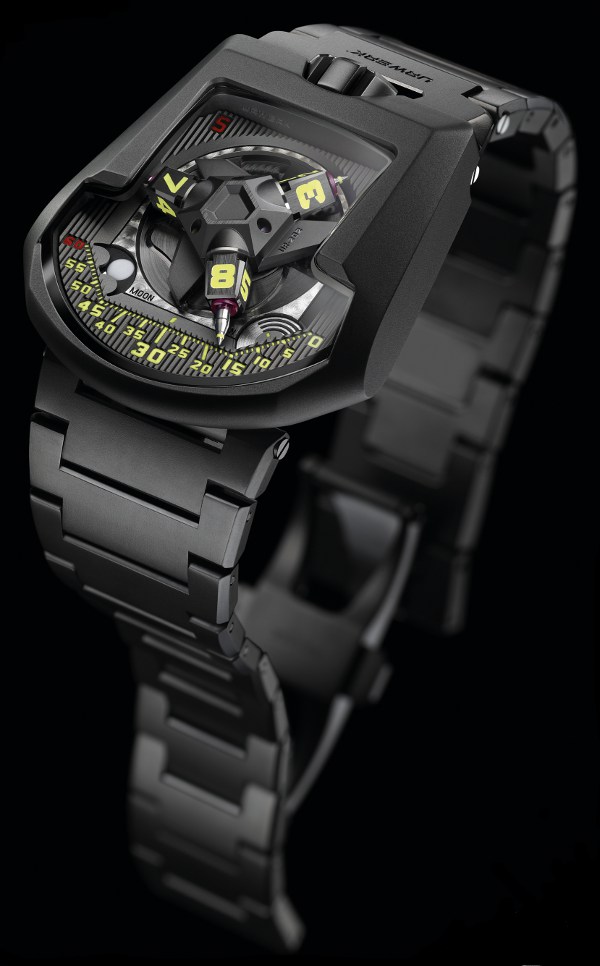

IMAD: Yeah, I was like, " What is this? Why is it so expensive? And you need to go back in time and realise that, uh, I think it was like twice the price of a Patek Philippe QP in Paris back in the days because of the pegging currency. So yeah, I didn't understand. Took me time to actually understand URWERK, the philosophy behind it.
UR: Obviously, URWERK has a very distinct visual design language, especially when you go back to the very beginning of URWERK, when there weren't that many independent brands- they were very unknown at that time. Most people only knew the big group watches like the IWCs and the Jaeger-LeCoultre as the ‘mainstream’. When you first saw URWERK, were you immediately convinced and like, wow, or was it something you had to learn about, to appreciate, or did you just immediately know?
IMAD: I immediately clicked with the design. It was so avant-garde. I'm like, wow, very futuristic design. It looks super nice. I didn't try it on the wrist at the time, but just looking at it was, wow, amazing. And once you try it on the wrist, even better.
UR: So that brings me to, what was your first URWERK?
IMAD: THE UR-105 CT in bronze. I love the bronze. I tried all the different 105 CT at the time, and I'm like, I love, I love this one in bronze. I don't own any bronze watch, and it will age with me. So this was the first thing. I love the hood, the carousel, everything about it. It's super nice.

UR: URWERK is built on a creative tension between Felix Baungarner, the watchmaker, and Martin Frei, the designer, which is unique in the watch world, even in the independent realm, to be co-owned by two people with two different fields of practise that come together to create. Is there one side of that equation that speaks to you more? Is it the mechanics, the design, or both?
IMAD: Both. It's just the mix. It's unbelievable. It's always hard to have two people at the head of a brand or a company because you know how it goes. I mean, you always have tension at the end of the day. We all know this in our work environment. But here I feel they know where they're going. They stay true to themselves all those years. And kudos to them and to their vision, really.
UR: Where do you see Urwerk sitting in the broader landscape of independent watchmaking today, and is that position understood or underappreciated?
IMAD: Look, they have a very niche position. I don't think they want to change this. It's not an objective, like, you know, you know me, I mean, I love your work, and whenever we have some collectors gathering, I always go with an URWERK, and people are like, wow, that's nice. It is nice, they like it, but they wouldn't buy it. Most of them would only buy the UR-101 or UR-102, which is like they just want something round and ‘normal’. But it's just the same thing that happened with me. People need time to understand URWERK. You just introduce them, and you just give them time; it’s a learning curve.
UR: Many of our collectors obviously also gravitate towards other independent brands, whether it's De Bethune, MB&F, Journe, or Richard Mille. Are you drawn to any of those?
IMAD: I actually own some of those pieces. MB&F, the Legacy Split Escapement in white gold. I also have the De Bethune DB28 Digital, which is super nice. It's beautiful. I have HYT, an H0. I do have a Ressence, the Type 1 Slim Black Dial and a Moser, which is the Endeavour Flying Hours.
But most of the time, the watch I wear the most is an URWERK.
UR: So what was your next acquisition in your URWERK journey?
IMAD: After the UR-105, I wanted the UR-103 Mexican Fireleg. I love the combination of colours. And keep in mind, every time I actually want, and I'm looking for a piece in the pre-owned market, as it’s a discontinued model, I try to reach out to URWERK first to see if you have a certified pre-owned one, but at the time, you didn’t have one. Luckily, I found one, as the Mexican Fireleg is not that easy to find; they’re very hard to come by.
UR: So your second watch was the 103, which is widely considered one of the founding references of URWERK. That was the first watch that really established the brand. So does owning one feel like you're holding a piece of the brand's DNA and history?
IMAD: The 103 is obviously the model that cemented URWERK as a brand. Although the Mexican Fireleg was one of the last of the UR-103s before being discontinued, for me, though, any piece of URWERK is part of the history of URWERK because it's an independent brand. They're gonna celebrate 30 years next year, which is an amazing achievement, by the way.
UR: On to your third of the URWERK collection, quite a step up in complication?
IMAD: The EMC. Oh my God, this one I've been looking for as well, and the time was right also, even though you know how many pieces I had to trade for this one.
UR: I do remember you traded in most of your mainstream collection. Do you want to say how many you traded in?
IMAD: I think fourteen or fifteen pieces, mostly Richemont brand pieces. It was crazy. I'm talking Richemont, IWC, Panerai, Jaeger-LeCoultre, plus Cartier, Zenith, and Grand Seiko. And you remember when I sent a photo of all the watches I was trading in on a tray, then when we all met up, Remy was like, dude, wtf! But I am happier this way, you know. I traded all those watches, but I'm happy about it. I'm actually happy wearing this watch and owning this watch. 
UR: How is owning a watch like the EMC? It is unlike any other URWERK that came before it. Obviously, uh, it puts you in direct dialogue with the movement, as you measure and regulate time. What attracted you to that concept, considering it was so different even in terms of URWERK?
IMAD: The movement, the design, some people look at it, they're like, it's a toy. I'm like, it's a control board. URWERK always invites you to interact with their watches, whether here or even on the 103. You turn the watch around, and you have a control board. 105, you have the turbine; you always like having interaction. And here it was awesome because in-house movement, manual wind, a Maxon® generator powered by a crank, the watch is beautiful just to wear. It looks like, I don't know, it's out of nowhere. It's different from what URWERK normally do, it even has normal hands!
UR: Did the lack of satellites, which we're normally known for, have any impact?
IMAD: No, because you always had this quirky interaction with the URWERK design, you know, a language that came with it. Yeah, so movement and design were there. This is pure URWERK for me.
UR: Moving on to your fourth and most recent URWERK, the UR-111C Black edition, tell us about that choice.
IMAD: Yes, my last purchase was the UR-111C Black. It's just crazy, all the complications in this watch, the design of a spaceship. Like, think about the jumping hours, linear retrograde minutes, digital minutes, and seconds— wow. The crown, you don't see it. You have the lever on the side; you can pull. It sits super comfortably on the wrist. I just love all those complications packed in one. 
I also sold four of my A Lange & Sohne watches to get. Like, this is how much I love and appreciate URWERK. And you saw me in the last few years also moving towards URWERK this way. And again, it's very emotional for me, and the relationship I have with URWERK has changed the whole dynamic because you need to be happy wearing a watch.
In terms of shaping the way I collect, look, my encounter with the URWERK team at Dubai Watch Week, I mean, 2022, changed my perspective. When I met Rémy, we clicked. Yacine, Pierre, you (Alex), Félix, I mean, this friendship started to build, the caring, and that's how, after this encounter, I increased my collection of URWERK pieces. Before that, I only had one.
UR: So, a difficult question, if you were to keep just one of your URWERK’s, you just couldn't let go, which one would it be and why?
IMAD: The answer might surprise you, but I'd keep the UR-105 CT because it's the first one I purchased and the one I had on the wrist when I met the whole team. So emotionally, even though it's not as complicated as a 111 or EMC, it's the one that I'm mostly attached to.
UR: That’s all, URWERK up to date, right?
IMAD: For now. But, you know me, you know my list for the past 2 years. I mean, I always had the 202 or 203, uh, this is one piece I need to add. Then once I found this one, I need to look at 210, 220, 230. I really like the 230, the Polaris and the Black Star. Super, super, nice. It is a mix of both.
UR: Okay, so that kind of leads me to our next question in your history of collecting watches: Was there ever one you really, really wanted, but you never managed to get, that got away from you?
IMAD: Wow. Yeah, that I didn't pull the trigger directly, uh, I mean, thinking about it, you have some pieces now, maybe not, the 202 at that time I didn't have the budget, it was a Full Metal Jacket one though. I'm talking maybe 2011, I didn't have the budget back then. Also, I was in Journe in Paris, I wanted the Optimum in black. So basically, you need to own another piece before you can buy one. So they showed me the regular one, which is super nice as well. I didn't pull the trigger. Now today, if you want to get an Optimum, you wait 4 years, and it's double retail. But I mean, do I regret any of those decisions? No, I think it was meant to happen, because if I had bought those watches in those days, maybe I wouldn't have had the budget to buy my URWERK watches today. You know what I mean? Everything has an impact at the end of the day.
UR: As a collector and watch lover, how do you live with your watches? Do you wear them daily, or only on special occasions? Do you leave them in the safe, or do you actually use them?
IMAD: No, I try to use them, especially the 105 and the 103, the easiest ones to wear. Yeah, now the 103 because I have the rubber strap and the weather is quite hot, so I switched to this one. I mean, just even having the folding strap, you know, it just fits so nicely. And again, for a watch that's 20+ years old, to bring a modern rubber strap out for a discontinued watch is quite cool. I wish more people would own the 103.
UR: So, one final question, if someone's thinking about making that leap into the world of URWERK, what advice would you give them?
IMAD: If you're in Geneva, go to the HQ, meet the team, talk to them, try the pieces and see how you feel about it. I mean, this would be it. If you're not, if you're in Dubai, go to the Dubai Mall, the Mall of the Emirates. Also, try the pieces, see if you're comfortable. The only thing they can do is to meet the team and try the pieces. Because it took me time, too. This journey takes time because you need to understand also, if you like this, why you're gonna spend so much money on this piece. You really want this piece. Take your time, don't jump. Don't go too fast, think about it.
UR: Thank you very much, Imad, for your time today and for sharing your watch-collecting journey and your passion for URWERK. It’s always a pleasure to sit with members of our Kollektiv and learn what draws them to URWERK, thank you.